Performative Ignorance: How Ideology Trains People to Defend Evil
By Virgil Walker | Sola Veritas

I was watching Greg Gutfeld last night when he used a phrase that stopped me cold: performative ignorance. It was a quick line, almost casual, but it named something I had been watching for years without quite having the language for it.
This wasn’t confusion. It was behavior.
The phrase came back to me when I saw a video circulating from earlier this week. Women, joined by a few men, were screaming at law-enforcement officers in broad daylight. Not asking questions. Not debating policy. Screaming. Phones raised. Faces locked in moral outrage. The officers stood their ground, disciplined and silent, absorbing the abuse.
What stood out wasn’t the shouting. It was what was missing.
There was no mention of victims, no concern for children, and no acknowledgment of the crimes that had made enforcement necessary. Rage was aimed upward toward authority, while the suffering that justified that authority vanished from view. The moral order was flipped.
Everyone involved knew better. Rape is evil. Murder is evil. Children should be protected. These are not controversial claims or specialized knowledge. They are basic moral truths written into the human conscience. And yet they were being actively suppressed.
That is what performative ignorance names.
You see it far beyond the streets.
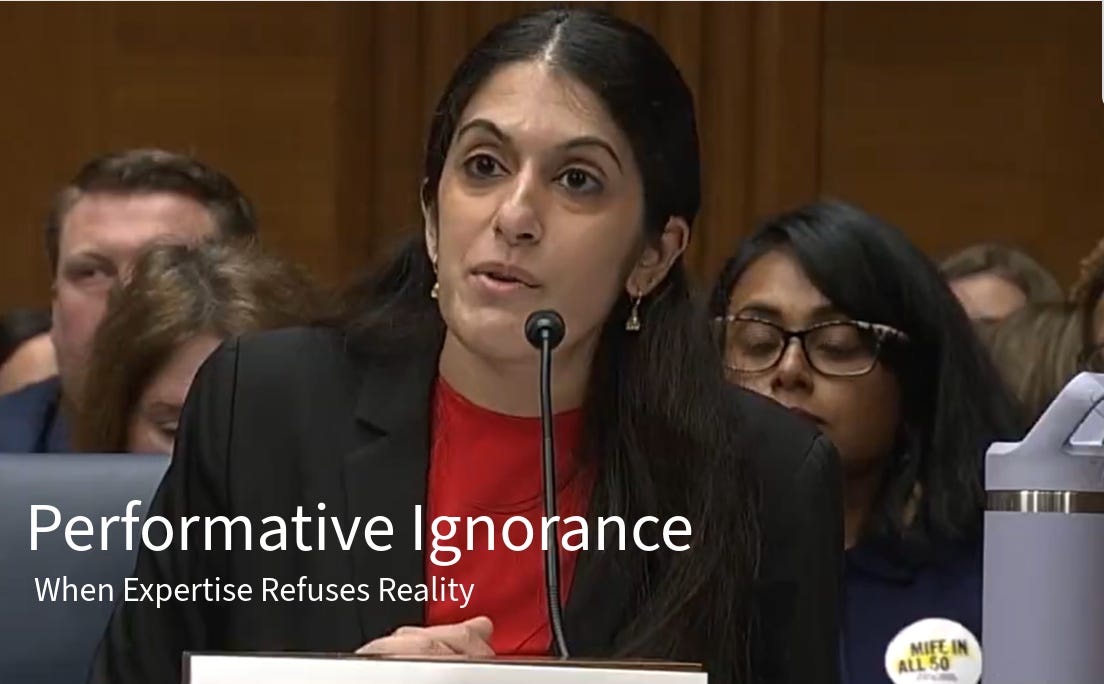
This is what happens when a board-certified obstetrician, Dr. Nisha Verma, is asked a direct question—Can men get pregnant?—and cannot bring herself to answer it. This is what happens when a judge being confirmed to the Supreme Court, Ketanji Brown Jackson, is asked What is a woman? and responds that she is “not a biologist.”
These are not hard questions. They are refused answers.
This is not intellectual humility. It is submission. When people at the highest levels of medicine and law pretend not to know what everyone knows, ignorance is no longer accidental. It is performed, and it is enforced.
Most people still claim to care about compassion and justice. They speak the language fluently and with confidence. On the surface, it sounds humane. But that surface agreement is where the deception begins.
When compassion is detached from truth, it becomes a performance. When justice is severed from reality, it turns into theater. When authority is redefined as oppression, evil gains room to operate without resistance. Performative ignorance borrows the vocabulary of virtue while emptying it of meaning.
This is not ignorance in the ordinary sense. It is not a lack of information. It is the deliberate refusal to acknowledge what is obvious because doing so would disrupt ideological loyalty. It is the public pretense of not knowing what everyone knows.
Words become negotiable. Definitions are treated as oppressive. Biology is framed as cruelty. Law is portrayed as violence. Yet the moment someone questions these claims, language suddenly regains its force, not to clarify reality, but to accuse. Disagreement is rebranded as hatred, clarity is treated as harm, and truth itself is cast as a threat that must be silenced rather than answered.
That is not how honest inquiry works. That is how control works.
At the center of this is authority.
God orders reality. Creation is not arbitrary. It is structured and intelligible. Male and female are not social experiments. Authority exists to restrain evil and protect the innocent, not to affirm feelings or reward rebellion. Scripture is clear that civil authority is appointed for public good (Romans 13:1–4).
When that framework is rejected, authority does not disappear. It is replaced. The self becomes sovereign. Emotion replaces truth. Power becomes the final arbiter. Once that inversion occurs, reality itself must be denied, because reality exposes autonomy as a lie.
This is why performative ignorance must be constantly reinforced. Lies do not stand quietly. They must be rehearsed, defended, and enforced. Dissent cannot be debated; it must be punished. At that point, the issue is no longer confusion. It is allegiance.
What matters most is not the policy debate itself, but the moral posture it reveals.

Yet outrage is aimed not at the crimes, but at the officers enforcing the law. The people screaming do not ask who was harmed or whether children are safer when predators are removed. Those questions would require acknowledging moral hierarchy and legitimate authority.
Instead, emotion is weaponized. Authority is personalized. Enforcement is reframed as cruelty. Performative ignorance trains people to react to symbols rather than reckon with reality. The uniform becomes the offense. The criminal disappears behind ideology.
Watching that scene, I had an uncomfortable thought. I could not do that job. I do not possess the patience those officers showed. Everything in me recoils at open contempt for lawful authority and the casual dismissal of victims. My instinct is toward immediate correction, not prolonged restraint.
That instinct points to something important, not about violence, but about order.
Unchecked disorder invites escalation. A culture that treats shouting as virtue and contempt as courage teaches people that defiance carries no cost. Over time, that lesson produces predictable outcomes, including violence that never had to happen.
The consequences of this inversion are severe. When authority is treated as evil, evil no longer needs to hide. When law is portrayed as violence, actual violence is reframed as resistance. When compassion is defined by ideological loyalty rather than truth, it becomes selective and cruel.
Scripture describes this pattern plainly. Suppressing truth does not leave people neutral. It hands them over to moral confusion that feels righteous while producing destruction (Romans 1:18–28). Isaiah warned of a people who invert moral categories until light and darkness exchange places (Isaiah 5:20).
This is why the issue is not merely political or cultural. It is theological.
Performative ignorance is what happens when God-ordered authority is rejected and replaced with self-rule. It is what happens when truth is negotiated, justice is redefined as affirmation, and compassion is detached from reality.
Christians cannot participate in this lie.
Reality is not hateful, but it does impose limits. Authority is not oppression, but it does restrain chaos. Truth is not violence, but it does confront lies. Protecting the innocent is not cruelty, but it does require moral clarity. A society that trains itself to deny these distinctions will eventually punish anyone who insists on remembering them.
Truth does not disappear when it is denied. It reasserts itself through consequences, through broken systems, and through the harm inflicted on those least able to absorb it. Reality always returns the bill.
No amount of screaming can cancel that reckoning.
Join the Mission
This moment demands more than outrage. It requires clarity, courage, and the refusal to pretend we don’t know what we know.
I write here to name the lies our culture normalizes, to defend truth when it’s treated as violence, and to call Christians back to moral order grounded in reality and Scripture.
If you’re tired of slogans replacing thought, of sentiment replacing justice, and of silence masquerading as virtue, join the work.
Free subscribers stay informed.
Paid subscribers help build the work that refuses to bend.
Truth is worth defending. Even when it costs.
Writing produced by the author, with limited use of digital tools for editing and clarity.
What a powerful commentary! Every word of wisdom so rich in thought and depth. Again, my generation “slept” through the quiet beginning of the assault on truth and now so aptly put, it has taken center stage as performative ignorance.
As a side note, I worked for 18 months for a law enforcement agency and was amazed at how they are abused and yet remain steadfast in their mission with no retaliation. I have such a high respect for these men and women. I, as you said, recoil at the vitriolic rhetoric spewed from these deceived people.
Powerful post! Perhaps what “shocks” us is our own improper understanding of our world. The “bad” behavior is the norm, not the aberration. Godly behavior is what’s unusual. I too read the scripture and encounter a world that is just as the Bible describes, yet am angered and frustrated. We must do a better job, and our pastors must do a better job of training us to see the world as it is and how we should live in that reality.